<table>
  <thead>
    <tr>
      <th style="text-align: left">Parameter</th>
      <th style="text-align: left">Description</th>
    </tr>
  </thead>
  <tbody>
    <tr>
      <td style="text-align: left">Codec</td>
      <td style="text-align: left">Select the codec used to refine the stream object type.</td>
    </tr>
    <tr>
      <td style="text-align: left">Use POIS</td>
      <td style="text-align: left">Only available with <strong>Conditioning</strong>.<br>Tick this checkbox if you want to define a POIS server.</td>
    </tr>
    <tr>
      <td style="text-align: left">PTS insertion compensation</td>
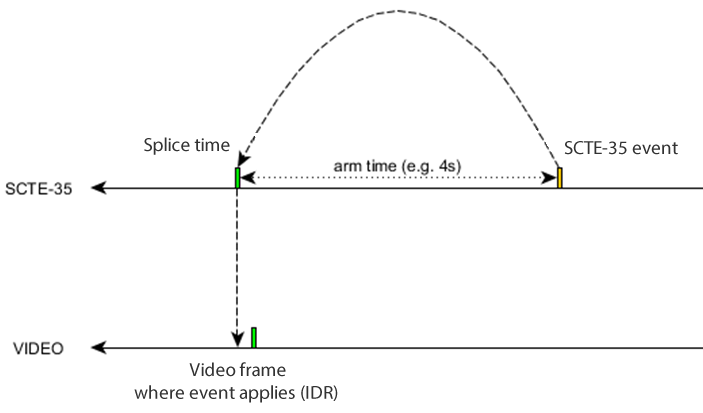
      <td style="text-align: left">Only available with <strong>Conditioning</strong>.<br>Enable pts insertion compensation.<br>If checked, the pts_adjustment of an SCTE-35 event will be adjusted so that the splice_time + pts_adjustment corresponds to the PTS of the video frame, as illustrated below:<br><img src="/images/legacy-live-encoder/pts-insertion-compensation.webp" alt="The arm time separates the SCTE-35 event from the splice time of the IDR video frame to which it applies."><br><strong>Note:</strong> Arm time is the time that separates the SCTE-35 event from its execution.</td>
    </tr>
    <tr>
      <td style="text-align: left">Recover conditioning state if failover</td>
      <td style="text-align: left">If 'By Controller' is selected, this option enables to keep the conditioning status after an encoder failover without the need of any external system.</td>
    </tr>
  </tbody>
</table>

## POIS parameters

<table>
  <thead>
    <tr>
      <th style="text-align: left">Parameter</th>
      <th style="text-align: left">Description</th>
    </tr>
  </thead>
  <tbody>
    <tr>
      <td style="text-align: left">Delay</td>
      <td style="text-align: left">If metadata stream is SCTE35, a delay adjusts the trigger time value.<br>Possible values: From 30000 to 60.000</td>
    </tr>
    <tr>
      <td style="text-align: left">URL</td>
      <td style="text-align: left">URL for the POIS (Placement Opportunity Information Service) (if any)</td>
    </tr>
    <tr>
      <td style="text-align: left">Network interface</td>
      <td style="text-align: left">Name of the network interface used to communicate with the POIS</td>
    </tr>
    <tr>
      <td style="text-align: left">Network name</td>
      <td style="text-align: left">ID shared with the POIS for the current channel</td>
    </tr>
    <tr>
      <td style="text-align: left">Zone identity</td>
      <td style="text-align: left">The area ID for this channel distribution. Commonly used for regionalization.</td>
    </tr>
  </tbody>
</table>

## Tissot clock metadata ID3 parameters

<table>
  <thead>
    <tr>
      <th style="text-align: left">Parameter</th>
      <th style="text-align: left">Description</th>
    </tr>
  </thead>
  <tbody>
    <tr>
      <td style="text-align: left">Period</td>
      <td style="text-align: left">Target frequency of sending encoded metadata.<br>If higher than the key frame period, encoded metadata will only be present on key frames.<br>Possible values: From 0 to 65535 ms</td>
    </tr>
  </tbody>
</table>

## Timecode ID3 parameters

<table>
  <thead>
    <tr>
      <th style="text-align: left">Parameter</th>
      <th style="text-align: left">Description</th>
    </tr>
  </thead>
  <tbody>
    <tr>
      <td style="text-align: left">Origin</td>
      <td style="text-align: left">Type of the timecode used to filter SMPTE 2038 input.</td>
    </tr>
    <tr>
      <td style="text-align: left">Period</td>
      <td style="text-align: left">Target frequency of the Timecode ID3 in ms.<br>Possible values: From 0 to 65535 ms</td>
    </tr>
  </tbody>
</table>