
API Concepts
Use these API concepts and data models when building MK.IO video workflows.

Four building blocks of the API
The MK.IO API is conceptually broken into four main parts: Inputs, Assets, Streaming Locators, and Streaming Endpoints.
Explore the API
Section titled “Explore the API”Inputs are the methods used to bring content into the system.
- Content is transformed into an Asset upon entry.
- Static content is uploaded to cloud storage and processed using a Job.
- Live content is ingested via a Live Event, with a time-shift buffer defined by a Live Output.
Storage
Section titled “Storage”Assets represent the location where content is stored in your cloud storage. They are decoupled from inputs, allowing the content to be managed and accessed at any point in the future.
Content protection and rewrites
Section titled “Content protection and rewrites”Streaming Locators connect DRM policies and filters to an asset, allowing a dynamic packager (JITP) to process the content. Locators handle DRM and manifest rewrites; you can create several locators for a single asset to support different business rules.
Publishing
Section titled “Publishing”Streaming Endpoints define the domain name for your content and provide options for integrating with CDNs. Streaming Endpoints are used for scaling your output and delivering content to global audiences.
Every Streaming Locator you create is available at every Streaming Endpoint within your project.
Authentication
Section titled “Authentication”Every MK.IO API request must be authenticated with an API token. See API tokens to create and manage tokens, and the Tokens API Guide for the authentication header format and token endpoints.
Data model
Section titled “Data model”Everything within MK.IO revolves around an Asset. File-based and live inputs are treated as assets on the output side.
Assets have policies attached to them via a Streaming Locator, which are then bound to a Streaming Endpoint for delivery.
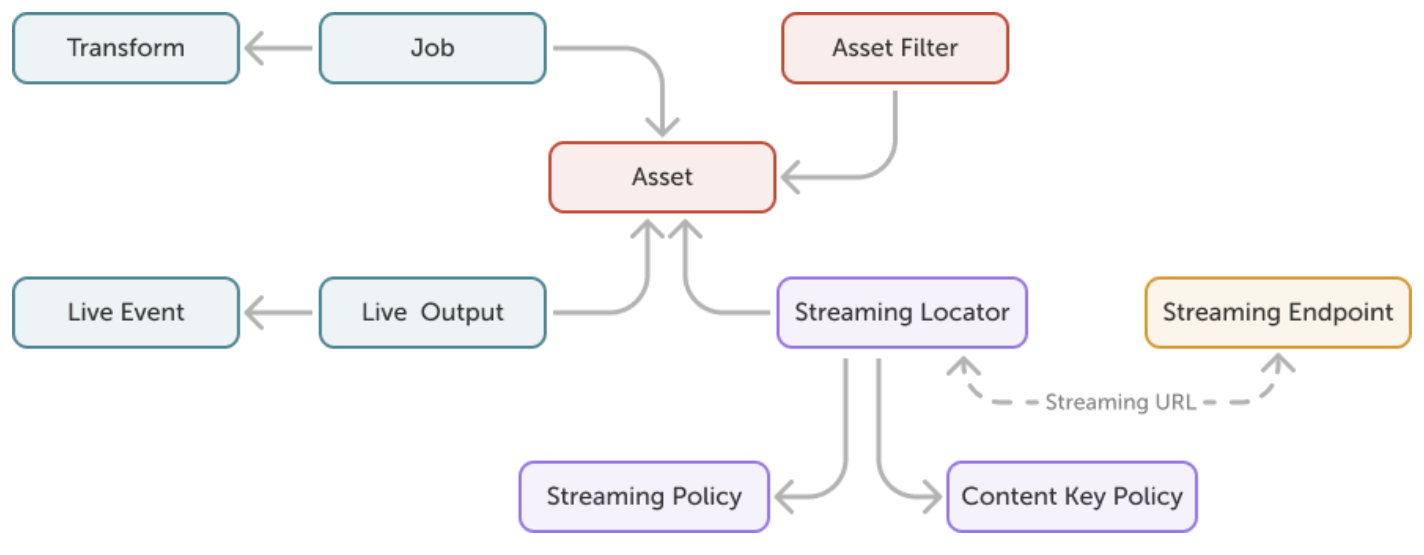
MK.IO Data Model Overview