
System and architecture description
The web interface provides a single access point to monitor components, manage users, and configure solutions from end-to-end. Configuration and control are separated for flexible resource allocation
Software and applicative layers
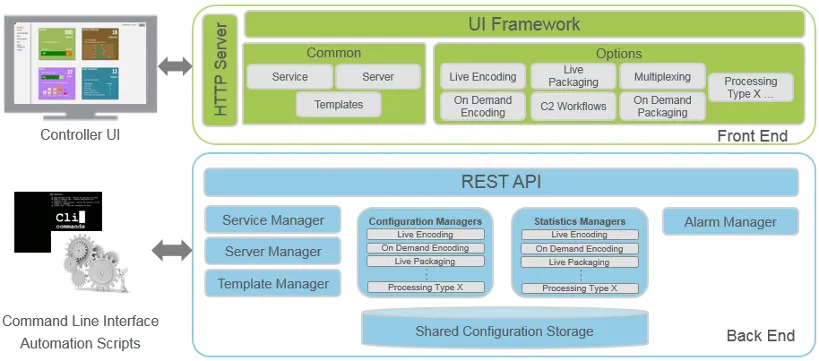
Section titled “Software and applicative layers”The platform design relies on a micro-services architecture to promote modularity and software component independence. The solution is split into a Front-End (UI) and a Back-End (API) layer. Each layer is interfaced through a REST API.
If menus or options in the web interface are grayed then contact your administrator about user rights.
UI Layer (Front-End)
Section titled “UI Layer (Front-End)”The generic UI framework provides a same environment to display the web pages for all compatible products:
- Web pages (services, servers, etc.) are shared across the product line.
- Certain web pages are specific to each processing type (statistics, services, etc.).
API Layer (Back-End)
Section titled “API Layer (Back-End)”The Back-End features are triggered through a REST API that can be used either from a Command Line Interface, or from the Front-End Layer. The API layer allows:
- A centralized redundant database.
- The logic handling for cross-products and product specific features.
High availability
Section titled “High availability”Management access is provided through a Virtual IP, allowing for a single connection access. This is based on an active/active implementation that ensures high availability.
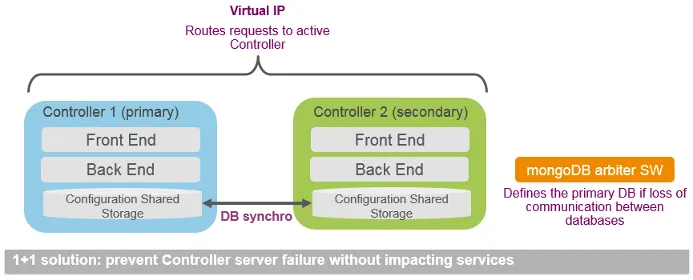
The database is synchronized in real-time between both nodes. In case of failure, the remaining node is instantly ready to process requests. If the primary server fails, then the Virtual IP is seamlessly re-assigned to the secondary server. This mechanism involves arbiter software, installed on a separate server. This arbiter server is in charge of electing the primary database if the network is partitioned (in the event of communication loss between synchronized databases).